
New Manager Returns to Savanna Portage State Park
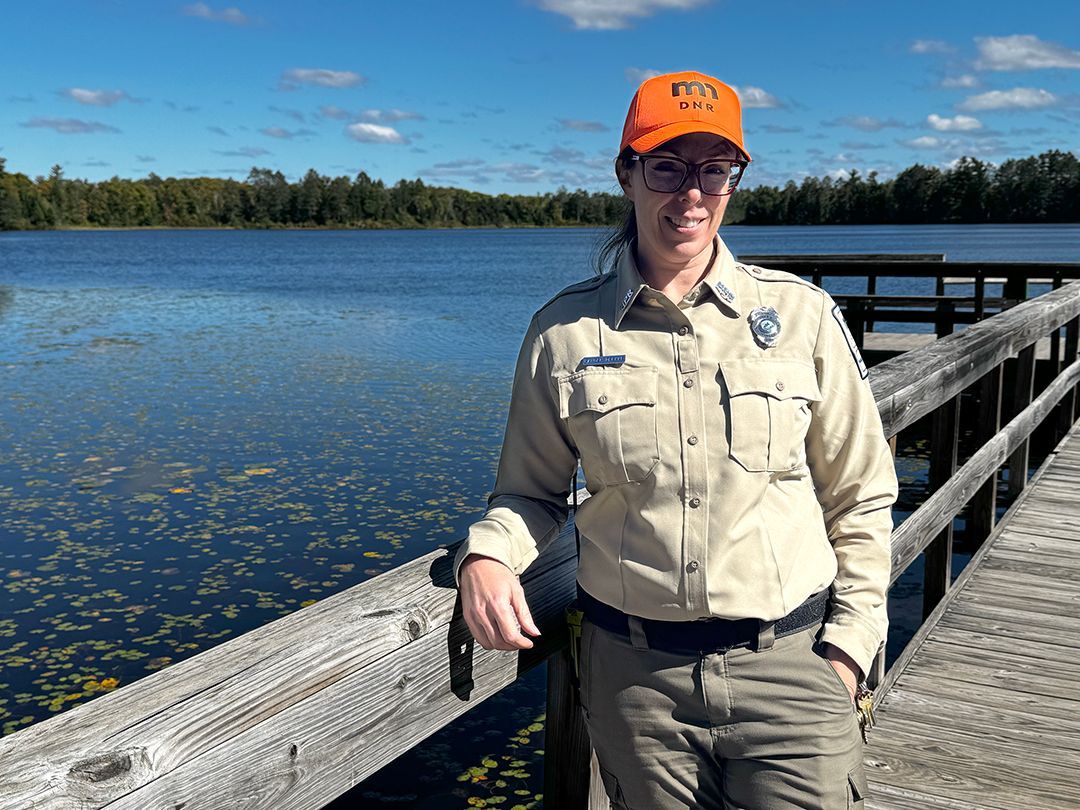
Joni Brekke becomes new manager at Savanna Portage State Park
McGregor, Minn. —
For Joni Brekke, becoming manager of Savanna Portage State Park has brought her career full circle. Brekke has served as park manager since July 2025, but her connection to the park began about 25 years ago when she worked there for three summers as a buildings and grounds worker and night security.
“I’ve kind of said my whole life that the best job I ever had was when I was a B&G (Building & Grounds) night security up here,” Brekke said.
A friend later sent Brekke the posting for the park manager position while she was working in the mining industry. Although she had been away from the parks system for many years, her friend encouraged her to apply. “I laid it on pretty thick in the application and in the interview,” Brekke said with a laugh. “Did I mention my daughter’s name is Savanna?”
She got the job, and today she oversees one of Minnesota’s largest state parks.
Managing a small city
Brekke describes the campground as a “small city” whose population changes from weekend to weekend. Her responsibilities include making sure visitors are safe, facilities are clean, trails are maintained and campers have a positive experience.
During the off-season, her work turns toward budgets, project planning, trail and facility maintenance and other long-term management needs. “There’s a lot of management that goes into that,” she said. “So it’s a large endeavor.”
Among the projects on her list are repairs to the boardwalk on the backside of Lake Shumway and eventually replacing the bridge leading toward Loon Lake. Projects at Savanna Portage can require considerable preparation because of the area’s cultural and archaeological significance.
“This whole park is basically an archaeological treasure,” Brekke said. “We can’t even dig a hole for a post without having an archaeological survey done.”
She said archaeological, cultural and environmental studies may be required before work can begin, meaning some projects can take a year or more to complete.
A historic link between great waters
That history is one of the things Brekke appreciates most about the park. The area known today as Savanna Portage was an important transportation route long before modern roads. The historic trail connected waterways leading toward the Great Lakes and the Mississippi River system.
The park’s historical information describes the American Indian trail system as one of the most important routes in North America during the fur trade era, linking the waterways of the Great Lakes with the Mississippi River.
Savanna Portage State Park was established in 1961 to preserve this important connection to the past. In 1973, because of its continental significance, the portage was listed on the National Register of Historic Places. The major fur-trade era extended roughly from 1780 to 1870, when nearby Sandy Lake ranked among important fur-trade centers.
The portage was used by Dakota and Ojibwe people before becoming an important route for explorers, voyageurs and fur traders. Historical information at the park notes that the portage varied from approximately six to 12 miles depending on water levels.
Brekke said a fire that burned the peat eventually transformed portions of the route into a difficult quagmire. “It became the absolute worst portage of the entire journey,” she said.
Historical accounts describe the route as especially difficult because of the bugs, bogs and challenging terrain. Voyageurs called it “the worst carrying place in the northwest.”
Today, visitors can hike a large portion of the historic Savanna Portage Trail, although the eastern 1.6 miles is currently minimally maintained.
Brekke said she particularly appreciates that local residents recognized the importance of preserving the portage. In the 1950s, community members organized a petition asking that the area be preserved as a state park. “To me, that’s also a really cool history,” Brekke said. “Those people that are from here love this area so much that they wanted to preserve it for everybody.”
The park’s history also reflects how difficult it can be to identify the exact original route. Historical research indicates the portage had alternate routes, while logging, ditching, changing water levels and weather have altered the landscape over the years.
A continental divide
The historic transportation route isn’t the only feature that gives Savanna Portage continental significance. A ridge running through the park forms a Continental Divide, separating waters that eventually flow toward two different major bodies of water.
An interpretive sign at the Continental Divide explains that, in geological terms, a divide is a high point of land separating water flows. At Savanna Portage, the divide has continental importance because the waters of the Mississippi River and the Great Lakes approach each other more closely here than at any other place in North America.
For Brekke, who has a background in hydrology, the feature is especially fascinating. “It’s a division of waters,” she said. “From the divide, water on one side eventually makes its way toward the Atlantic Ocean by way of the St. Louis River and the Great Lakes. Water flowing in the opposite direction travels through Big Sandy Lake into the Mississippi River, eventually reaching the Gulf of Mexico.”
The result is a remarkable geographic point where rainfall or melting snow can begin journeys in two different directions.
“Everything from Wolf Lake, and over that way, all goes east,” added Brekke. “All the remaining lakes flow west to Big Sandy Lake and eventually into the Mississippi.”
Visitors can hike to a viewing platform along the Continental Divide Trail overlooking Wolf Lake. The climb can be challenging, but Brekke said the view helps visitors understand the significance of the divide. “You can overlook Wolf Lake, and that’s the best I can do for showing people the division of waters,” she said.
For visitors standing on the ridge, the concept becomes tangible: waters beginning on one side of the high ground eventually travel toward Lake Superior, while waters beginning on the other side ultimately enter the Mississippi River system.
The park’s interpretive sign describes the location as a rare opportunity to witness the simultaneous beginnings of long journeys in different directions.
A park built for discovery
The history is only part of what draws Brekke to Savanna Portage.
The park encompasses more than 16,000 acres and offers more than 22 miles of trails, along with four lakes, extensive forests, wetlands and wildlife habitat.
Some trails are relatively flat and suitable for visitors looking for an easier hike, while others, including the Continental Divide and Esker trails, offer more challenging terrain.
Wildlife is abundant. Visitors may encounter deer, turkeys, bears, raccoons, beavers, eagles, swans, loons, ducks, bobcats and other species. Brekke has also observed wolves in the park, and a moose has been spotted along the Continental Divide Trail.
The park’s lakes provide fishing opportunities, while winter visitors can enjoy ice fishing and cross-country skiing.
Brekke also encourages visitors to experience the park after dark. Because of its remote location and limited artificial light, the night sky can be spectacular. “Here, when you look up, some people have never seen the Milky Way before,” she said. “And you come up here, and there it is.”
A place to disconnect
Perhaps the most appealing feature of Savanna Portage is something visitors won’t find on a trail map — solitude. “People come up here who’ve never been here before, and they’re like, ‘This place is a hidden gem,’” Brekke said. “You don’t come here by accident. We are so far off the beaten path.”
The road ends at the park, and cell phone service is limited.
For Brekke, that’s part of the attraction.
Visitors ride bikes, hike, sit around campfires, cook outdoors, watch wildlife and spend time away from their phones and the distractions of everyday life. She said one of the most rewarding parts of her job is seeing families and children discover the park. She gives young visitors junior ranger books and badges and enjoys watching children become excited about the natural world.
She also appreciates the simple moments that come with patrolling the park — checking docks and boats, looking across the lakes and seeing swans and loons. “I get paid to do this,” she said. “It’s so cool. And so beautiful. And it’s peaceful.”
For Brekke, returning to Savanna Portage has meant coming back to a place where history, water, wildlife and people intersect.
More than two decades after first working at the park, she now has the opportunity to help preserve that history and introduce a new generation of visitors to the same landscape that challenged Dakota and Ojibwe travelers, explorers and voyageurs centuries ago.
.