
Antique Hay Press Highlights White Pine Show
Self-feeding Swayne Robinson press produces 68 bales during two days of demonstrations
September 2026 • Voyageur Press
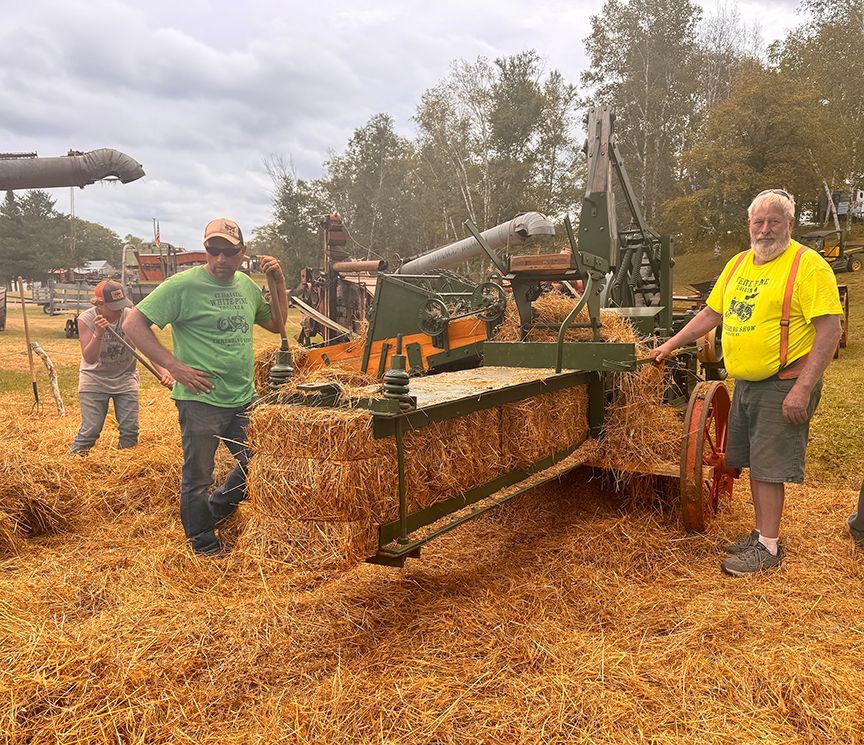
McGRATH, Minn. — The 48th annual White Pine Logging & Threshing Show featured plenty of antique machinery over Labor Day weekend, but one recent addition to event organizer John Langenbach’s collection attracted particular attention — a Swayne Robinson & Co. self-feeding hay press believed to date to approximately 1918.
Langenbach recently purchased the press near Knoxville, Wisconsin, and brought it home shortly afterward. Manufactured by Swayne Robinson & Co. of Richmond, Indiana, the more than century-old machine is unusual because of its self-feeding attachment.
“We’ve got a bunch of presses, but this has got the self-feeder,” Langenbach explained while demonstrating the machine. “I’ve never seen another one with a feeder on it.”
The attachment allowed loose hay to be mechanically fed into the press instead of requiring workers to continually load the hay by hand. Langenbach said the system made the operation more efficient. During two days of demonstrations, a crew of helpers put the antique press to work and produced 68 bales of hay.
The demonstration gave visitors an opportunity to see firsthand how early farm machinery operated. Large gears, shafts and other mechanical components worked together to feed, compress and bale the loose hay.
The hay press was one of numerous working pieces of agricultural history featured during the annual event.
400 Tractors Fill the Parade
A major highlight of the White Pine show is its annual tractor parade, and this year’s parade was an especially impressive display. More than 400 tractors participated, and the parade took approximately two and a half hours to complete. The lineup included a wide variety of antique and vintage tractors representing generations of agricultural technology.
This year’s featured manufacturer was Case, with Case tractors and equipment receiving special attention throughout the show. Case traces its agricultural roots to 1842, when Jerome Increase Case founded the Racine Threshing Machine Works in Racine, Wisconsin. The company initially became known for threshing machines before expanding into steam engines and tractors.
Case’s long history made its equipment a fitting feature for a show dedicated to preserving the development of farming and rural life. Visitors could see Case machinery alongside equipment from other manufacturers as the massive tractor parade made its way through the grounds.
Visitors Travel From Georgia
The White Pine show also attracted visitors from well beyond the McGrath area, including Glenda and Tad Isaacs of Georgia. The Isaacs met John and Nancy Langenbach while camping in Florida and developed a friendship that eventually brought them to Minnesota for the White Pine event.
The couple spent the week at the show, camping on-site and helping with various projects. They regularly travel and volunteer with historical societies and other organizations along the way. Tad grew up on a farm and appreciated seeing the antique machinery, although he said much of the equipment at White Pine was older than anything he had personally used.
The couple said they have attended other historical machinery shows, but were impressed by the sheer amount of equipment assembled at White Pine. “It’s amazing, the stuff that accumulates,” they said.
They also enjoyed seeing machinery they had never personally operated, including an antique baler that used wire rather than twine.
For Langenbach, the Isaacs and the many volunteers who make the show possible, events such as White Pine are about more than displaying old equipment. They provide an opportunity to demonstrate the technology, hard work and ingenuity that shaped agriculture for generations.
This year’s show did exactly that — from a century-old self-feeding hay press producing 68 bales to more than 400 tractors rolling through a two-and-a-half-hour parade.
About White Pine Logging and Threshing Show
Want to learn more about White Pine Logging and Threshing Show? Find their location, hours, contact information, and more about the organization and what they offer.
Upcoming Events
The White Pine Logging and Threshing Show is an annual celebration of Minnesota’s logging, farming, and rural heritage, showcasing historic equipment, demonstrations, exhibits, and activities that honor the hard work and traditions that shaped the region’s communities.
Click on an image to view it larger
More Articles about our White Pine Logging and Threshing Show
2022 - Long Journey Home
August 30, 2022 • Voyageur Press
The S.S.J.LANGENBACH will be on display at the annual White Pine Logging and Threshing Show near McGrath September 3-5
McGREGOR, Minn. —The Langenbach family is well known for putting on the annual White Pine Logging and Threshing Show at the farm near McGrath. The show is most known for the 200-plus antique tractors on display, but the event also includes shingle making, logging and barrel making demonstrations. They also have an onsite newspaper demonstration with the old printing press and much more.
This year, the Langenbachs are excited to display a family heirloom they recently discovered on the television show American Pickers. “I got a call from my kids while we were in Key West,” said John. “They said they had seen a model ship on American Pickers. It had the name S.S.J.Langenbach on it.”
The Langenbachs knew immediately this was a piece of family history that had slipped away. Turns out their Uncle Johnny was a Merchant Marine during World War II who built several model ships in the 1940s. John and Nancy decided to make a few stops on their way home from Florida — the Antique Archaeology stores (Home of the American Pickers). They first stopped at the one in Nashville, Tennessee. “We arrived at the store and no one knew anything about the ship,” recalled John. “So we continued on to LeClaire, Iowa, their original story.”
They inquired again at the store and again no one seemed to know anything about the ship. “We hung around and explored another building and one lady said, ‘I think Dave has the boat.’”
Dave Ohrt is one of the recognizable faces on the American Pickers show. “The lady called and texted Dave and we decided to get a bite to eat,” recalls John. “Covid hit and the stores closed down that day.”
A year would pass before the Langenbachs could resume tracking down the ship. Dave decided to attend a car auction near LeClaire after some time had passed and this time he brought pictures and a brief history of his Uncle. “During his down time on the ships,” said Nancy, “he built four to six model ships. He built them out of whatever extra items they had on the ship.”
Tragically, in 1949, at age 46, Uncle Johnny died while undergoing surgery for a brain tumor. He never married and did not have any children. In honor of Johnny, Billy and Silvia Langenbach named their next born son, John Langenbach.
“The Langenbach children remember seeing the ships in the attic of the original Langenbach farmhouse in Geise, Minnesota,” added Nancy. “At some point the ships disappeared, likely being sold to antique dealers. Billy along with his children always kept an eye out in antique stores hoping to one day run across one of Uncle Johnny’s ships.”
After leaving his contact information at Antique Archaeology on three separate occasions (twice in Iowa and once in Nashville), numerous unanswered emails, Facebook messages and voicemails and 13 months after the episode had first aired, John luckily ran into another familiar face on American Pickers, Mike Wolfe’s brother, Robbie, at the auction.
“I introduced myself and let him know that I just wanted 30 seconds of his time,” said John. “I told him I am looking for this ship. My uncle built it and it has my name on it. He took my information and called Dave.”
John figured it was another dead end, but Robbie made the contact. “He said we don’t typically give our numbers out but do you have a piece of paper? ‘Here’s Dave’s number.’”
John immediately called him up and arranged to meet him at his home. Dave agreed to sell the ship. Dave had ultimately purchased the ship from Mike Wolfe. “He was the nicest guy,” said Nancy. “He took us to his home where he had tons of cool stuff.”
John agreed. “He is super nice. He invited us back anytime.”
In a July 21, 1940 Duluth News Tribune article titled “6-Foot Liner To Be Masterpiece For Builder of Miniature Boats”, Uncle Johnny began his hobby at the age of 25. His ships were built using sugar pine, white wood, mahogany and maple for the woodwork. Copper and brass were used for the propellers and stacks. A saw, jack-knife and electric soldering iron were the principal tools used.
According to the Tribune, the ships were displayed in and around the Duluth area.
Langenbach's hobbying comes quite naturally for he has spent a considerable portion of his life on the water. Fourteen years of his time have been devoted to sailing the Great Lakes.
Such a career furnished him with the proper background for an understanding of vessels and their construction down to the minutest detail.
Says the Finlayson resident, “Sailing as much as I have, you would think some other hobby would be more interesting to me. That’s not the way it works out, though. Guess I’ll never get tired of the lakes or of being near boats. At least one thing is sure, I’ll never tire of making miniature ships whether I’m a sailor or landlubber.”
2009 - From The Ashes of a Fire
July 21, 2009 • Voyageur Press
Although it was built in 1896 with charred lumber from the Hinckley Fire, the former Emmanuel Lutheran church that until recently was located by Grindstone Lake near Sandstone, has a proud history. In order to preserve that history when the Sandstone congregation decided to construct a new building, the church was privately purchased and donated to the White Pine Show Grounds in McGrath.
On Sunday, July 12, at 2:00 p.m., approximately 150 people gathered to take part in a dedication celebration welcoming the church, which was moved from its location of 112 years in Dell Grove Township in December 2008, to the White Pine community.
A calm, sky-blue interior welcomed guests who crowded into the little white chapel for the day’s celebration, which was dedicated to Billy and Sylvia Langenbach, founders of the White Pine Logging & Threshing Village, a historical community established in 1979. Billy and Sylvia’s son, John Langenbach, shared that they started having church services at the village in the mid ‘90s, but they had no place other than the saloon to hold their meetings. This really bothered John’s mother, Sylvia Langenbach, until the pastor told her, “What better place to find the sinners?” And, John said, his mother was okay with it after that.
“But,” added John, “now we have a great building, and I’m sure she’s looking down on us and smiling.”
Nancy Sylvester, Emmanuel Lutheran member who, along with her husband John, purchased the building for donation, shared a story she composed that told the building’s history from the viewpoint of the church. Her reading revealed that in the early years the members spoke Swedish, but in 1935 they changed the official language to English and changed the church name from Swedish Evangelical Lutheran to Emmanuel Lutheran.
The church’s history also includes many members from the early 1900s who have descendents to the third, fourth, and even fifth generation who are now current members.
Rod Nelson, nephew to Bill and Sylvia, who runs the sawmill at White Pine, was the one to initially discover that Emmanuel Lutheran needed a home. Rod got the ball moving that resulted in the church’s relocation. Rod explained how Bill and Sylvia’s dream that started the White Pine Logging & Threshing Show included a church.
This was a festive polka praise festival with music provided by Gary Martens on the accordion accompanied by son Rick Martens, and between speakers, guests sang joyously along to toe-tapping praise music.
Other speakers included Pastor Brenda Wicklund, Emmanuel member, who shared fond memories of days at the church, and Pastor Arnold Swanson, who served Emmanuel from 1987 to 1995. Pastor Swanson drew plenty of laughter when he remarked on an earlier comment about sinners being found in the saloon by saying, “This church is no stranger to sinners!” In a more serious tone he continued, “One of the characteristics of the Bible is the call to remember. … So let’s remember how this church had its roots – literally in the ashes of a fire. … People gather in a church like this to remember who they are, where they’ve come from, and to think about where they’re going,” Pastor Swanson exhorted.
Closing remarks by Rick Martens, included a reference to James 2:18: “But if someone will say, ‘one person has faith and another has actions,’ my answer is, Show me how anyone can have faith without actions. I will show you my faith by my actions.”
“James talks about faith in action,” Rick said. “I think that’s what the founders of this church did. They showed their faith through the actions of building a community of faith to come and worship. And it’s also a great testament to Bill and Sylvia and the family that’s continuing the logging and threshing show here. They take the action that others will know that there were hard times, there were good times, and when we come together in a community of faith, nothing is impossible, especially when God is on our side.”
Rick continued with a dedication of the building to the grounds and a prayer that the church would continue to be “a place for the gathering of people of God, a place for proclaiming the Gospel through word and sacrament, and a place for bringing life and hope to us and this community.”
Another polka praise service will be held at White Pine Chapel Sunday, Sept. 6, at 9:00 a.m. during the Logging & Threshing show taking place Labor Day weekend.
2005 - Folks at the White Pine Logging and Threshing Show were busy rolling out Barrels
September 13, 2005 • Voyageur Press
A popular new feature at the White Pine Logging and Threshing Show this year was the White Pine Barrel Company. The featured exhibit actually represented a 1900s Nail Keg maker. Folks who attended the show could purchase a custom-made barrel or planter, after watching the interesting process used to make one.
A couple of people who purchased barrels were Ken Bahr and Mary Ellen Becker. Mary Ellen attended the White Pine Show this past Monday, September 5. She shared that she came all the way from Iowa to get a barrel. “Actually, we had them made for our cabin on the Snake River,” she said.
Ken Bahr spent a great deal of time chatting with barrel maker Robert Haas. Ken noted that Robert makes one barrel and then cuts it into two to make planters. “He gets $30 for a barrel, then cuts it in half and charges $40,” he joked.
Robert quipped back, “Now you can plant twice as many flowers.”
The real reason the planters are more expensive is the extra hardware and labor required to make one. Robert, who is a cabinet maker, was very busy this weekend. He shared that he made plenty of barrels, but it seems like he seldom made the right color. On Monday, the color of the day was natural red cedar. “Yesterday, it was mixed cedar colors; yesterday they wanted barrels; today they want planters.”
“And some wanted pine,” added Doug Langenbach who organizes the White Pine Show and is the owner of the barrel making business.
Doug decided to get into this business when he discovered that the Englund Threshing Show in Isanti was shutting down. “This equipment was set up at that show, and I asked if I could purchase it,” he said.
The answer was yes, so Doug, his brother John, his son Steve and David Haas all pitched in to make it happen. According to Doug, they had little time to get ready for this year’s Threshing Show, but they quickly added a new shelter for the equipment and set up the barrel making business on the grounds.
There are four stations included at the barrel making exhibit. The first step is to cut staves (strips of wood curved to form the round shape). A Barrel Saw is used for this purpose. Next, a machine called a Crozer routers a groove in the stave for the barrel top and bottom. Third, the stave receives bevel from a machine called the Wheel Jointer. The final station is the assembly. It is here that all the pieces come together and are held together with a band.
Next year, Doug plans on adding a machine that will make assembly much easier. A Bander Machine is available that will crimp, punch holes, crease, and expand the band to fit the tapered barrels. “We also plan to make bigger barrels,” added Doug. “Cheese barrels that are 42 inches.”
Doug concluded by stating that the response from those who watched the barrel making process was fantastic. He can’t wait until next year. “We will have a little more time to prepare and not be rushed,” he concluded.
2003 - Silver Anniversary
September 9, 2003 • Voyageur Press
The White Pine Logging and Threshing Show at the Langenbach farm near McGrath, Minn. has made quite a transformation the past 25 years. Back in 1979 the show consisted of eight tractors, 12 exhibitors, and it rained both days. Quite a contrast to the 2003 show that consisted of over 275 tractors, about 225 exhibitors and the sun shining all three days. The parade, which lasts two hours, is held each day.
The show drew over 4,000 people this year, and weather was a contributing factor. Last year, it poured. “There have only been two years out of the 25 that it hasn’t rained,” said Nancy Langenbach who organizes the show. “I still remember the first show when it rained both days and there was no shelter. We huddled under the eave of the kitchen. It seemed to be sunny out the following day and that’s why we added the extra day.”
The White Pine show was a dream of Bill and Sylvia Langenbach and their family that has become reality. According to Bill’s son John, “We’re here to have fun... it’s family entertainment, it’s a good time and you have to be a little crazy.” The show is so big now that there are as many as 50 volunteers and staff members working the grounds.
Many of them are Langenbachs. John and Nancy have two sons and a daughter working. They all do a little bit of everything. John’s oldest son, Jeremy, works the corn chopper and drives the tractors in the parade; Robby can be found planing wood near the sawmill and Samantha takes care of the buildings and works at the front gate. “Wherever they are needed,” added Nancy.
Todd and Diane also have three children. Their son, Jacob, works in the feed mill and daughter, Stephanie, helps check wrist bands. Daughter, Nicole is seven years old and she sells buttons.
Doug and Sandy have older children who are married and have children of their own. They all pitch in somewhere. Kim is Doug and Sandy’s daughter, and she helps mom in the pop shed. The grandchildren are eager to help as well. Their son, Steven, owns and runs two large steam engines. Doug and Sandy also have two son-in-laws working, Mike Bird and Shanin Klontz.
Another significant helper at the show is Robert Nelson, who is Nancy and Diane’s father. That’s right, John and Todd married sisters, Nancy and Diane Nelson. For those keeping up with the Centennial and All School reunion theme this summer, all four are McGregor graduates.
According to Nancy, she married first and Diane saw what a good deal she had. Diane’s response, “That’s not true. There wasn’t much to choose from in McGregor.”
The family relationship has grown right with the show over the years. Robert Nelson became a tractor collector shortly after his girls married the boys. He now has 15 John Deere tractors. The Nelson connection with the show doesn’t stop there. Robert’s son Ricky Nelson (McGregor grad, 1982) helps make shingles and his wife, Kathy (Bottila) Nelson (McGregor grad, 1986) does all the jobs nobody wants to do.
All the help is much needed because the celebration is so big. Exhibitors come from all over. Each year, the miniature city in the country expands. Plans are in place to add another building and the lumber sawed during demonstrations will be used for just that purpose. People come to the show from all over. John Langenbach explained that several people come from all over Minnesota, Wisconsin and other states as well. “We’ve had exhibitors from New Mexico, and we had a guy bring a tractor for quite a few years from southern Indiana.”
One couple from Truman, Minn., had nothing but accolades for the Langenbachs and their show. Lyle and Mary Larsen, who have attended the White Pine Show the past two years, feel this is one of the best shows in the country. “We will be back here next year,” said Mary. “These people (the Langenbachs) are so nice!”
Lyle agreed. “This is one of the nicest shows we go to,” said Lyle who attends an average of 10 shows per year all over the country.”
Lyle felt there were only two other shows that were about as good as this one. One is in Arizona and the other is the John Deere Expo in New York.
According to Mary, in addition to the White Pine show, next year they will be attending one in Florida and one in Ohio. Lyle and Mary’s tractor was truly a hit at this year’s show. The miniature tractor was completely built by Lyle. The R Diesel dates back to around 1949 to 1954 and was the first diesel marketed by John Deere. To make their exhibit even more interesting, it is driven by Oscar, who, according to Lyle, is the only one who will drive the tractor.
In addition to the many tractor exhibits, there is a little bit of something for everybody. There is an old print shop run by local printer, Mike DeCoursey. His father, Fred DeCoursey, was the publisher of the Mille Lacs Messenger at one time. The DeCoursey family have been a fixture at the White Pine show since 1988 when the Cranston Newspaper Press arrived from
McGregor High School. Each year, the press produces the White Pine Times, the official newspaper of the White Pine Show.
The shingle making has been an attraction since the show started. Ron Weiss, commander of the American Legion in Forest Lake, Minn. was busy branding shingles on Sunday. Ron is a friend of the Langenbachs and he recalls riding the school bus to McGrath School. “Bill Langenbach was my bus driver for 12 years,” said Ron. That was about 60 years ago.”
Ron then noted that the shingles come in 50 custom designs and that they sell over 800 of them.
The many exhibits are too numerous to mention, but a few of the main ones include: threshing activities, the White Pine Toy & Model Shop, the Antique Car building, the Caboose, the White Pine Light Plant, the Saw Mill, the Blacksmith Shop, the White Pine Mill and Pump House, the Schlafle Log House, the Post Office, the Tronnes School and buildings full of engines big enough to power small cities.
This is the Silver Anniversary of the White Pine Show and Nancy reminds people not to confuse it with their wedding anniversary. John and Nancy have been married for 27 years. Now Todd and Diane, on the other hand, have been married for 22 years. It won’t be long before there is another Silver Anniversary celebration in the Langenbach family.